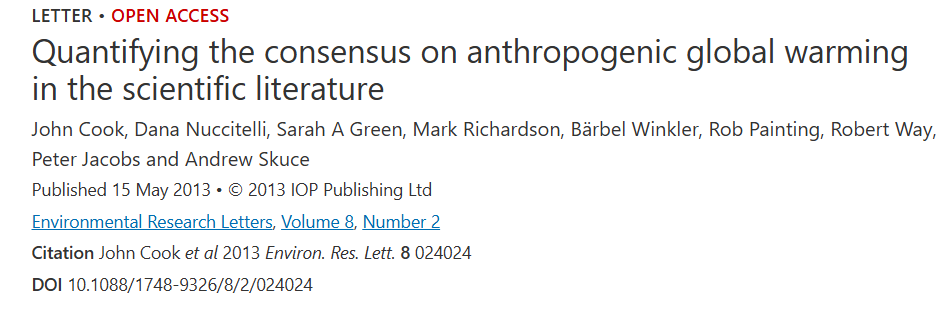
Climate science communication is a complex and often contentious field. One particularly influential piece of research has been the 2013 paper by John Cook et al., “Quantifying the consensus on anthropogenic global warming in the scientific literature.” This study, frequently cited as evidence of a “97% consensus” among climate scientists, is often presented as a gold standard of scientific rigor. However, beneath its widely quoted headline lies a nuanced story about authorship, transparency, and the ethics of scientific communication.
In this post, I’ll unpack why the Cook et al. paper, produced entirely by contributors to the science communication website Skeptical Science, raises important questions about peer review, disclosure, and the fine line between misinformation and disinformation.
[Note – The embedded references are causing a problem – and experiment with chat GPT – I’ll work through them, you can probably track them down quickly with Chat GPT/Google]
The Background: Skeptical Science and the 2013 Consensus Study
Skeptical Science is a popular “climate communication” platform founded by John Cook in 2007, initially aimed at debunking climate misinformation for the General Public (Cook, 2007). Over time, it grew into a network of volunteers, many passionate about climate advocacy but not necessarily experts in physical climate science or science communication, nor the field of social science research. Any ethical oversight (if any) and “peer review” is internal to Skeptical Science and non transparent, they are only accountable to themselves, or John Cook as the website owner – with a few friends that can log on.
In 2013, this group published a landmark paper in Environmental Research Letters that analyzed nearly 12,000 peer-reviewed abstracts to quantify the scientific consensus on anthropogenic global warming (AGW) (Cook et al., 2013). The paper concluded that approximately 97% of the relevant literature supports human-caused global warming — a figure that has since become a staple talking point in climate debates (Anderegg et al., 2010; Cook et al., 2016).

The Problem: Who Authored the Paper?
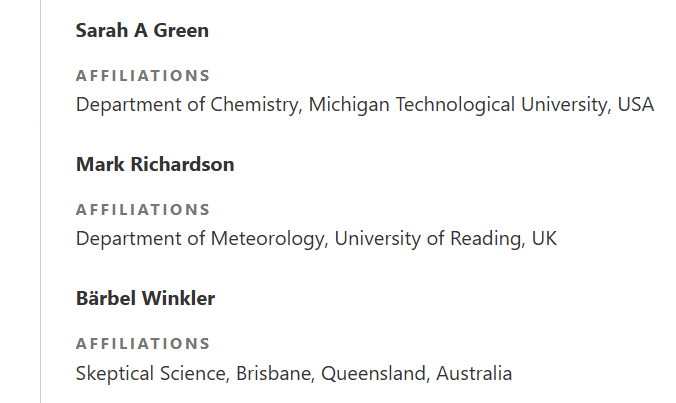
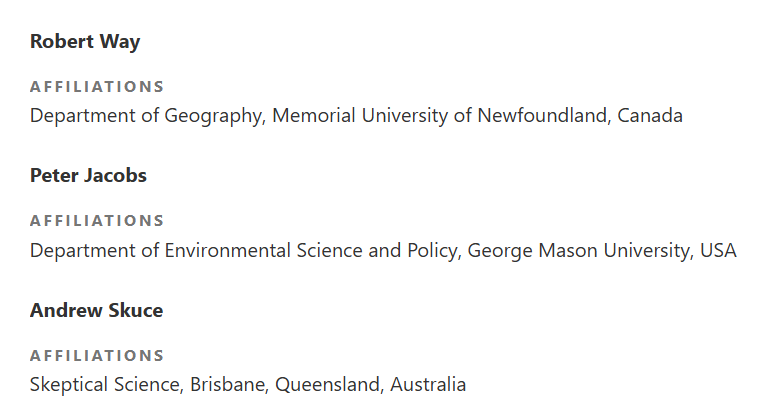
The critical detail often glossed over is this: All the authors of the Cook et al. paper were contributors to Skeptical Science. Many had backgrounds far from climate science—ranging from psychology to education, policing, and environmental activism. Only a few had formal scientific training related to climate or physics. About half of the authors declared a Skeptical Science affiliation, ~ half did not – ie, Sarah Green, Robert Way and others, just declaring a University affiliation.


More importantly, the Consensus Project was conceived, organized, and executed entirely within the private online forums of Skeptical Science. This means that the team was essentially a single-entity group, albeit with multiple contributors . Link to the Cook (2013) Consensus paper
Why Does This Matter?
Scientific publishing norms require authors to disclose all relevant affiliations and potential conflicts of interest (COPE, 2023). Such disclosures allow editors, peer reviewers, and readers to evaluate research in its proper context and to assess potential biases.
In this case, the authors did not explicitly disclose that the project was a Skeptical Science–coordinated effort with all contributors affiliated with the same advocacy platform. Some authors listed formal university affiliations, while others did not, creating an uneven picture of the team’s diversity and independence (Unsettled Climate analysis, 2025).
This omission matters for several reasons:
- Potential Bias and Groupthink
When a study is executed entirely by a single advocacy group, the risk of shared biases and groupthink increases. This is especially significant given that the study required subjective categorization of abstracts—a task prone to interpretation and bias (Lewandowsky et al., 2017). - Misleading Presentation
Editors, peer reviewers, and readers likely assumed the research involved a broader and more independent team of climate scientists and experts than was actually the case (Nottingham University, 2020). - Ethical Transparency
The lack of disclosure undermines trust in the research process. Transparency is a foundational principle of scientific integrity; withholding key contextual information violates this principle (COPE, 2023).
Is This Disinformation?
This is a nuanced question. Disinformation implies deliberate intent to deceive (Wardle & Derakhshan, 2017). There is no public evidence that the Cook et al. authors intended to mislead. The omission of Skeptical Science affiliation could have been a serious oversight or a misunderstanding of disclosure norms.
However, withholding this information had the practical effect of misleading readers and reviewers about the study’s independence. By definition, this is a form of misinformation—and depending on intent, it could reasonably be interpreted as disinformation.
Moreover, partial disclosure, where some authors listed formal academic affiliations and others did not, compounds the problem. This inconsistent transparency creates a “grey area” that undermines confidence in the study’s objectivity (Unsettled Climate analysis, 2025).
The Broader Implications for Climate Communication
The Cook et al. study has been enormously influential in climate discourse. Its conclusions are frequently cited in scientific, media, and political contexts to assert near-universal consensus on human-driven climate change (Oreskes, 2004; Cook et al., 2016).
While consensus is important, the process by which it is communicated and the trustworthiness of those communicating it are just as critical.
If influential climate communication platforms blur the lines between advocacy and research without clear disclosure, they risk:
- Eroding public trust (Lewandowsky et al., 2017),
- Providing ammunition to climate misinformation campaigns (Cook et al., 2017), and
- Undermining the credibility of genuine scientific consensus (Oreskes, 2004).
What Can We Learn?
- Transparency is paramount. Authors must fully disclose affiliations and funding sources—even if they believe these do not influence their work (COPE, 2023).
- Peer review depends on honesty and clarity. Reviewers cannot properly assess a paper without knowing who is behind the research (COPE, 2023).
- Communication platforms should clearly separate advocacy from original research (Nottingham University, 2020).
- Critical readers and journalists should always seek the primary scientific literature and be cautious of meta-analyses led by advocacy groups (Lewandowsky et al., 2017).
Conclusion
The Cook et al. consensus paper was a milestone in climate communication, but it is also a cautionary tale about the importance of scientific transparency and ethics.
Without full disclosure of affiliations and conflicts of interest, even well-intentioned efforts can inadvertently mislead. In an age of polarized debate and climate misinformation, we must hold all climate science communicators and researchers to the highest standards of transparency and integrity.
If we want to build public trust and effectively address climate change, we must be honest not only about the science but also about who is doing the science and how it is being communicated.
References
- Anderegg, W. R. L., Prall, J. W., Harold, J., & Schneider, S. H. (2010). Expert credibility in climate change. Proceedings of the National Academy of Sciences, 107(27), 12107–12109. https://doi.org/10.1073/pnas.1003187107
- COPE (Committee on Publication Ethics). (2023). Guidelines on authorship and disclosure. https://publicationethics.org/authorship
- Cook, J. (2007). Skeptical Science About Global Warming Science. SkepticalScience.com. https://skepticalscience.com
- Cook, J., Nuccitelli, D., Green, S. A., Richardson, M., Winkler, B., Painting, R., … & Skuce, A. (2013). Quantifying the consensus on anthropogenic global warming in the scientific literature. Environmental Research Letters, 8(2), 024024. https://doi.org/10.1088/1748-9326/8/2/024024
- Cook, J., Lewandowsky, S., & Ecker, U. K. H. (2017). Neutralizing misinformation through inoculation: Exposing misleading argumentation techniques reduces their influence. PLoS ONE, 12(5), e0175799. https://doi.org/10.1371/journal.pone.0175799
- Cook, J., Oreskes, N., Doran, P. T., Anderegg, W. R. L., Verheggen, B., Maibach, E. W., … & Rice, K. (2016). Consensus on consensus: a synthesis of consensus estimates on human-caused global warming. Environmental Research Letters, 11(4), 048002. https://doi.org/10.1088/1748-9326/11/4/048002
- Lewandowsky, S., Ecker, U. K., & Cook, J. (2017). Beyond misinformation: Understanding and coping with the “post-truth” era. Journal of Applied Research in Memory and Cognition, 6(4), 353-369. https://doi.org/10.1016/j.jarmac.2017.07.008
- McNeall, D. (2021). Personal communications on climate science transparency. [Twitter and blog posts].
- Nottingham University. (2020). Making Science Public Blog: On Climate Communication and Consensus Metaphors. https://blogs.nottingham.ac.uk/makingsciencepublic
- Oreskes, N. (2004). The scientific consensus on climate change. Science, 306(5702), 1686. https://doi.org/10.1126/science.1103618
- Wardle, C., & Derakhshan, H. (2017). Information disorder: Toward an interdisciplinary framework for research and policymaking. Council of Europe Report DGI(2017)09. https://rm.coe.int/information-disorder-toward-an-interdisciplinary-framework-for-researc/168076277c
- Unsettled Climate analysis. (2025). Internal analysis and review of Cook et al. (2013) authorship transparency. [Blog post draft].
Why I’m as Much a Science Communicator as Anyone at Skeptical Science
I’ve had the privilege of contributing to Watts Up With That? and Bishop Hill – over a decade ago now Platform with large and engaged audiences — and organizing guest posts for leading climate scientists such as Professor Richard Betts. I’ve also facilitated a guest contribution by BBC’s Roger Harrabin. At the time, there was a political consensus on climate change in the UK, (Climate Change Act 2008) so discussions at Bishop Hill blog (Andrew Montford were not caught in the bi-partisan politics of the USA at the time. Sadly Bishop Hill has been largely defunct since 2016 – and the readership and community has evaporated away. So I had hoped that I could build a few bridges, where the WUWT audience and commentators were quite cyncical about climate scientist – only knowing about the ones they saw in the media.
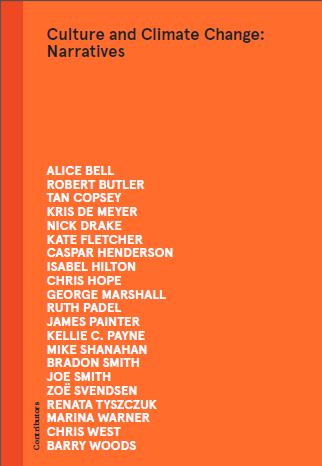
Additionally, I’ve participated in panel debates hosted by the Open University and contributed to an Open University book. These experiences have given me valuable insights into communicating complex climate issues to diverse audiences.
Science communication isn’t just about self-identifying as a “communicator.” It’s about engaging honestly, transparently, and rigorously with the evidence and the public. It requires both the willingness to listen and the responsibility to clarify qualifications and potential biases.
That’s why when groups like Skeptical Science present themselves as authoritative without full disclosure of their backgrounds and affiliations, it’s right to ask critical questions about transparency and trustworthiness.
Final Note (this was an experiment in using ChaptGpt to help research and edit blog posts)
Ref – Unsettled Climate analysis (2025) – I made use of ChatGpt to collate references and effectively work as my sub editor (recommended in the past that I REALLY needed one) – I will post up the raw material of that discussion, in a later blog post – all words are my responsibility, ChatGpt is can be a useful tool and it is not ‘intelligent’ – and any author has to know the subject material , otherwise things could go very wrong.


![oreskes-mcneall[1]](https://wattsupwiththat.files.wordpress.com/2015/05/oreskes-mcneall1.jpg?w=720)